


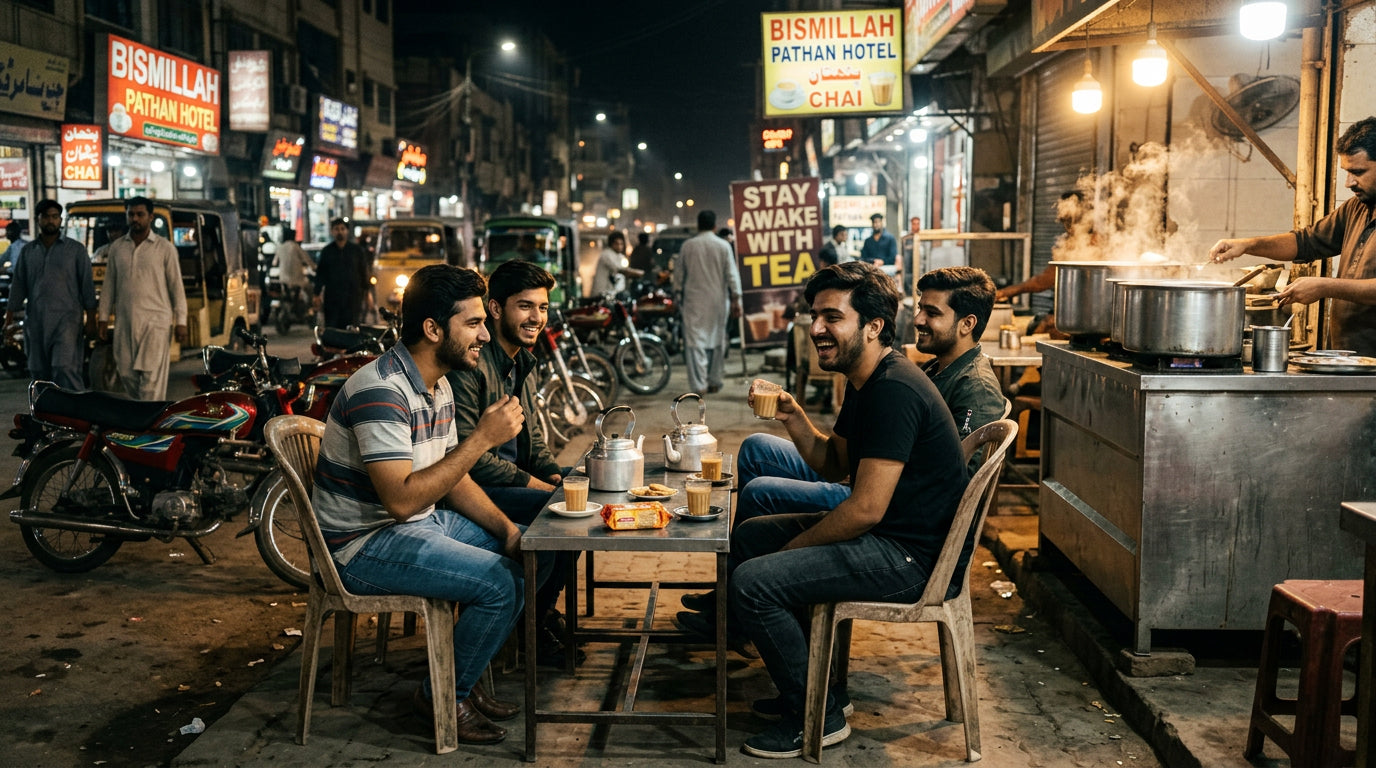
Pathan ka Dhaba, Every Night, Since You Were 16: What Karachi's Chai Culture Is Actually Doing to Your Body
If you grew up in Karachi, you know exactly what this looks like. It is 1am. You are sitting on a plastic chair outside a dhaba somewhere in Defence, Gulshan, Orangi, or North Nazimabad. There is a karak chai in a glass that has been rinsed but not washed. There is a ceiling fan doing nothing against the July heat. There are four friends, two phones face-up on the table, and a conversation that will solve nothing but feels like it is solving everything. This is Karachi. This is also, quietly, a nightly mineral drain that is building up a physiological debt your body will eventually present as a bill.
This article is not an attack on chai or on the dhaba. Both are load-bearing parts of Karachi's social architecture. What it is, is an honest account of what the nightly ritual actually does inside your body, because nobody else is telling young Karachiites this, and they deserve to know.
Key Takeaways
- A nightly dhaba sitting stacks three things at once: tannins that block minerals, caffeine that flushes them, and a very late bedtime.
- Magnesium drives the GABA pathway that lets you fall asleep, so the timing of the last cup matters as much as the number of cups.
- Keeping the final chai a few hours before bed, and away from your evening meal, removes most of the mineral cost.
Why This Is a Karachi Problem Specifically
Pakistan has a national chai culture. But Karachi has something different. In most Pakistani cities, chai is a morning and afternoon ritual, consumed at home or at work. In Karachi, chai is a nighttime social institution. The Pathan ka dhaba model, small street-side stalls serving karak chai around the clock, has proliferated across every neighborhood of the city over the past two decades. It is not uncommon for a young Karachiite to sit at a dhaba three to five nights a week, drinking two to four cups per sitting, between the hours of 10pm and 3am.
This pattern, high volume, late timing, repeated weekly, creates a mineral depletion profile that is distinct from daytime chai consumption. Here is why the timing and volume both matter more than most people realize.
What Chai Actually Does to Your Mineral Levels
Tannins Block Absorption
Black tea, the base of every karak chai, contains polyphenols called tannins. The national picture of what chai costs Pakistan in calcium and magnesium sets out the scale of it. Tannins bind to minerals in the digestive tract, forming insoluble complexes that your gut cannot absorb. The minerals most affected are iron, magnesium, calcium, and zinc. For calcium, this daily loss compounds into bone density concerns over years, which is why Calcaria-Vit (calcium carbonate plus Vitamin D3) is particularly relevant for regular chai drinkers. Research has consistently shown that consuming tea with or immediately after a meal reduces mineral absorption by 50 to 70 percent for that meal.[1]
When you drink chai at a dhaba at midnight, after whatever you ate at dinner a few hours earlier, you are not just failing to add minerals. You are actively blocking the absorption of whatever your evening meal provided. Two to four cups across a sitting compounds this significantly.
Caffeine Accelerates Urinary Loss
Caffeine has a well-documented diuretic effect that increases urinary excretion of calcium and magnesium. Every cup of tea you drink causes your kidneys to excrete more of these minerals than they otherwise would. For someone drinking three cups at a late-night dhaba sitting, this represents a measurable net loss on top of the absorption interference already happening from the tannins.[2]
The Late-Night Timing Makes It Worse
Magnesium is critical for sleep quality. The wider signs of running low on magnesium are easy to miss until sleep starts to go. It activates GABA receptors in the brain, the chemical pathway that allows your nervous system to slow down and transition into sleep. When you deplete magnesium late at night through multiple cups of caffeinated, tannin-rich tea, and then try to sleep at 2 or 3am, your brain is both chemically stimulated by caffeine and physiologically short on the mineral it needs to wind down. Replenishing with Magnova (magnesium glycinate) before bed on dhaba nights directly targets this window.[3][4]
dietary magnesium supplementation brought about statistically significant increases in sleep time. Abbasi B et al., Journal of Research in Medical Sciences, 2012
The result is the classic Karachi young adult sleep pattern: cannot fall asleep easily, sleep is light and unrefreshing, waking up is brutal, and by afternoon there is a fatigue that another chai temporarily masks but never resolves. The chai that caused the problem becomes the solution that perpetuates it.
The Hygiene Question Nobody Talks About Enough
This section requires a degree of care because it addresses practices that are widely observed and reported but vary across individual vendors. What follows represents commonly documented public health concerns around informal food service, not a blanket indictment of every dhaba operator in Karachi.
The Cup Rinsing Problem
In a high-volume street dhaba environment, cups cycle quickly. Proper dishwashing requires hot water, detergent, and time. What most high-volume dhabas practice is a fast rinse in a bucket of water that is changed infrequently. The World Health Organization has documented that improper utensil sanitation in informal food service settings is one of the primary transmission vectors for gastrointestinal pathogens including E. coli, Hepatitis A, and typhoid, all of which are endemic in Karachi.[5]
The practical implication is that a cup rinsed in tepid shared water and handed to you 30 seconds later has not been disinfected. It has been rinsed. These are meaningfully different things. For someone drinking chai from the same dhaba three nights a week for years, cumulative low-level exposure to gut pathogens is a legitimate concern, particularly because chronic gut inflammation directly reduces the absorption of magnesium, calcium, and iron, compounding the mineral depletion that the tea itself is already causing.
Frothy Chai and What Is Actually in It
Karachi's karak chai is famous for its froth, the thick foam that sits on top of a well-made cup. Genuine froth comes from vigorous boiling of full-fat milk with tea. It takes time, skill, and quality milk. At a busy dhaba serving fifty cups an hour at midnight, not every cup gets that treatment.
There are widely circulating and frequently reported concerns, documented by food safety journalists and community health workers in Karachi, that some vendors use unapproved foaming agents or milk adulterants to produce froth quickly and cheaply. Common adulterants reported in Pakistani informal dairy supply chains include detergents, hydrogen peroxide, and synthetic whiteners. These are not proven to be present in every or even most dhabas, but they represent a documented risk category in informal food supply settings that Pakistan's food safety regulatory bodies have formally acknowledged.
The honest summary is this: you do not know what is in the milk at a dhaba you have been going to since you were 16. You trust it because it is familiar, and because nothing acutely bad has happened. Chronic low-level exposure to adulterants does not produce an immediate dramatic response. It produces gradual, diffuse health deterioration that is easy to attribute to stress, bad sleep, or just being a young person in Karachi.
The Sedentary Sitting Pattern
A dhaba sitting is not just about the chai. It is about sitting in one position for two to four hours, late at night, with minimal movement. This matters because sedentary late-night behaviour suppresses melatonin production, keeps cortisol elevated, delays the body's natural circadian wind-down, and means the mineral depletion from the chai is happening in a body that is already physiologically stressed.[3]
The irony is that the dhaba sits feel like rest. They feel like the one part of a Karachiite's day where nothing is being demanded of them. But physiologically, the body is not resting. It is sitting under artificial light, processing caffeine, losing magnesium through its kidneys, and being asked to sleep in a few hours.
What This Looks Like at 25, 30, and 35
The depletion is gradual enough that most people do not connect the dots. But here is a realistic physiological trajectory for someone who has been doing this since their teenage years:
• By 25: Persistent fatigue that chai temporarily fixes. Difficulty sleeping despite genuine tiredness. Occasional muscle cramps dismissed as dehydration.
• By 30: Chronic low energy that no amount of sleep seems to fix. Increasing anxiety or irritability attributed to work pressure. Hair thinning beginning.
• By 35: Bone density loss beginning earlier than it should. Higher blood pressure. Gut issues that have been present for years but never fully resolved.
None of this is inevitable. But none of it is random either.
What to Do Without Giving Up Your Chai
The goal here is not abstinence. It is informed compensation. If you are drinking two to four cups of chai per night at a dhaba several nights a week, you are running a consistent mineral deficit. Supplementing with magnesium glycinate before bed on those nights does three things simultaneously: it compensates for what the tannins and caffeine have depleted, it supports the sleep quality that late-night caffeine has disrupted, and it addresses the cortisol-driven wakefulness that keeps you staring at the ceiling at 3am.[4][6]
• Take 200 to 400 mg of magnesium glycinate 30 to 60 minutes before bed on dhaba nights
• Space it at least an hour after your last cup of chai to avoid tannin interference with absorption
• On nights when you are drinking chai early and eating a decent meal, food-based magnesium from almonds and pumpkin seeds helps top up the gap
• If you suspect gut issues from years of informal dining, a probiotic course is worth discussing with a doctor, since gut health directly determines how much magnesium and calcium you absorb from both food and supplements
Want to offset the cost? Magnova (Magnesium Glycinate) by Nimble Pharma uses pharmaceutical-grade ingredients and is available for home delivery across Pakistan. Shop now at nimblepharma.shop
Frequently Asked Questions
Is chai actually bad for you?
Not categorically. Tea consumed in moderation during the day, with meals, in reasonable quantities, has documented antioxidant benefits. The concern here is specifically high-volume, late-night consumption in an environment with additional hygiene and quality uncertainties. The dose, timing, and context are what create the problem, not chai itself.
How do I know if I am magnesium deficient?
The most common signs in young Karachiites are chronic fatigue that chai temporarily relieves, difficulty falling asleep despite exhaustion, leg cramps at night, and frequent headaches. A blood test measuring serum magnesium is available at most labs in Karachi, though it is worth noting that serum magnesium does not fully reflect cellular magnesium stores, so clinical symptoms matter as much as the number.
Should I stop going to dhabas?
That is your choice to make with full information, which is what this article is trying to give you. The dhaba is a real and valuable part of Karachi social life. What changes when you read this article is not whether you go, but whether you understand what it costs you physiologically and how to offset that cost.
Is the adulteration concern overstated?
It is a genuine and documented public health concern in Pakistan's informal food sector, not a conspiracy theory. Whether any specific dhaba you visit uses adulterants is not something anyone can tell you with certainty. What is certain is that informal food supply chains in Pakistan have known adulteration problems, that the regulatory enforcement of street food vendors is limited, and that the risk is real enough to take seriously without being certain.
Can magnesium fix the gut issues from years of dhaba food?
Magnesium glycinate is gentle on the gut and actually supports intestinal muscle function and motility, which can help with symptoms like constipation or irregular digestion. However, established gut damage from pathogens or chronic inflammation needs proper medical assessment. Magnesium is supportive, not curative, for gut health.
References
1. Hurrell RF, Reddy M, Cook JD (1999). Inhibition of non-haem iron absorption in man by polyphenolic-containing beverages. British Journal of Nutrition.
https://pubmed.ncbi.nlm.nih.gov/10999016/
2. Shaikh MK et al. (2016). Nutritional assessment of tannins on mineral bioavailability in high tea-consuming populations. Pakistan Journal of Nutrition.
https://scialert.net/abstract/?doi=pjn.2016.1.8
3. Pickering G et al. (2020). Magnesium status and stress: the vicious circle concept revisited. Nutrients.
https://pubmed.ncbi.nlm.nih.gov/33260549/
4. Abbasi B et al. (2012). The effect of magnesium supplementation on primary insomnia in elderly: a double-blind placebo-controlled clinical trial. Journal of Research in Medical Sciences.
https://pubmed.ncbi.nlm.nih.gov/23853635/
5. World Health Organization (2019). Food safety: key facts on street food hygiene and contamination. WHO Technical Report Series.
https://www.who.int/news-room/fact-sheets/detail/food-safety
6. Ranade VV, Somberg JC (2001). Bioavailability and pharmacokinetics of magnesium after administration of magnesium salts to humans. American Journal of Therapeutics.
https://pubmed.ncbi.nlm.nih.gov/11550076/
Medical Disclaimer: This article is for informational purposes only and does not constitute medical advice. Always consult a qualified healthcare professional before starting any supplement. Individual results may vary.